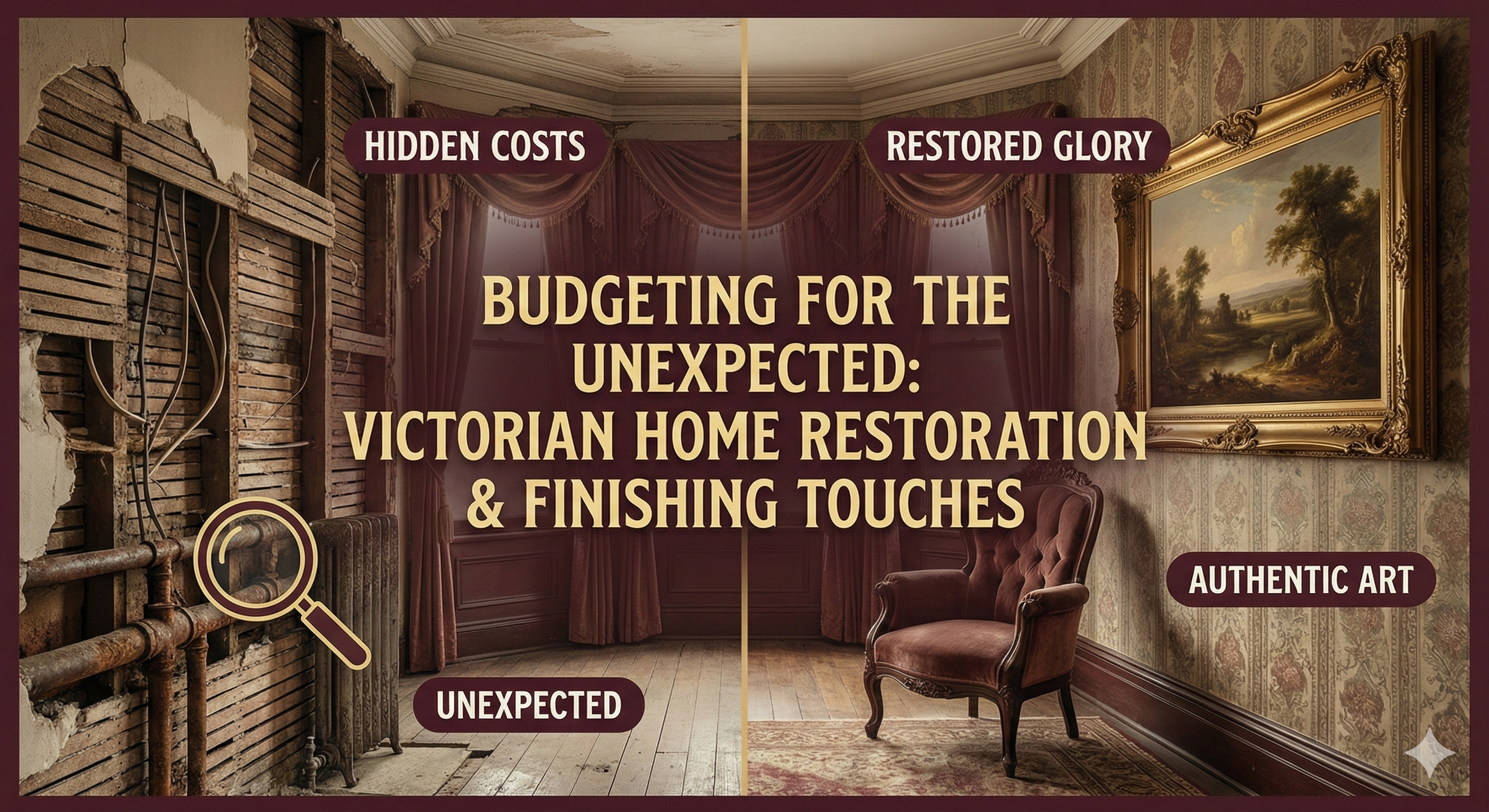
You've fallen in love with a Queen Anne with original gingerbread trim, or maybe an Italianate with brackets that somehow survived 130 years of Midwestern winters. The bones are good, the price is right, and you can already picture the parlor with period-appropriate wallpaper.
Then reality arrives with the first contractor's estimate.
I've spent fifteen years restoring Victorian homes—my own and others'—and the gap between expectation and reality never gets smaller. This isn't a guide to paint colors or where to source reproduction hardware (though we'll get there). Consider reading about the Victorian money pit. This is what I wish someone had told me before I signed the papers on my first 1887 Folk Victorian.
The 40% Rule: Why Your Budget Is Already Wrong
Every restoration professional I know uses some version of this rule: take your initial budget and add 40%. Not because contractors are dishonest or because you'll change your mind about finishes. Because Victorian homes hide their problems behind horsehair plaster and balloon framing.
What's actually behind that 40%:
- Knob-and-tube wiring that wasn't visible during inspection but runs through every interior wall
- Lead paint remediation that jumps from "encapsulation" to "full abatement" once you start opening walls
- Plaster keys that have failed on 60% of your ceilings, not the 20% you could see
- Foundation work that reveals the "minor settling" is actually a crumbling limestone footer
- Code compliance for egress windows, stair railings, and electrical panels that didn't exist when the house was built
The 40% isn't pessimism. It's pattern recognition from thousands of projects.
Balloon Framing: The Victorian Feature That Keeps Fire Marshals Up at Night
If your home was built before 1930, there's a strong chance it uses balloon framing—continuous wall studs that run from the foundation sill plate to the roof rafters, sometimes three stories without interruption.
This was efficient. It was also a chimney waiting to happen.
Why this matters for your restoration:
Modern platform framing includes fireblocks at each floor level. Balloon framing doesn't. A fire starting in the basement can reach the attic in minutes through the hollow stud cavities.
When you open walls for electrical or plumbing work, you're required in most jurisdictions to install fire blocking. This isn't optional—it's code. Budget for it, because the alternative is a failed inspection and redoing finished work.
The retrofit approach:
- Mineral wool insulation in stud cavities acts as a fire retardant while improving energy efficiency
- Intumescent caulk at penetrations (pipes, wires) expands when heated to seal gaps
- Metal fireblocking plates at floor transitions where access is limited
One project I consulted on had the homeowner budget $8,000 for insulation. The final fire blocking and insulation package came to $23,000—still worthwhile, but a shock when they'd already committed to a kitchen timeline.
The Window Question: Restoration vs. Replacement (and Why the Math Isn't What You Think)
The window replacement industry has spent decades convincing homeowners that original wood windows are energy sieves that must be replaced with vinyl or fiberglass units. The actual data tells a different story.
The thermal performance reality:
A properly restored wood window with a high-quality storm window achieves an R-value of approximately 2.0 to 2.5. A mid-range replacement double-pane window typically achieves 3.0 to 3.5.
That difference—maybe R-1.0—translates to roughly $15-25 in annual heating costs per window in a moderate climate. With restoration costing $300-600 per window and replacement running $800-1,500 (properly installed, with period-appropriate trim work), the payback period on replacement for energy savings alone extends past 50 years.
What actually matters for window efficiency:
- Weatherstripping condition accounts for 60-70% of air infiltration
- Storm window fit matters more than the primary sash glazing
- Sash cord and pulley function determines whether the window can close completely
- Glazing putty integrity prevents both water intrusion and air leakage
The restoration process worth paying for:
A legitimate restoration shop will strip paint to bare wood (often revealing old-growth timber with grain density you can't buy today), replace failed glazing compound, re-rope sash weights, install modern weatherstripping in period-invisible channels, and repair any rot with consolidated wood or dutchman patches.
The result lasts another 100 years. The vinyl replacement has a 20-30 year lifespan and will eventually end up in a landfill.
Plaster Walls: When to Save Them and When to Let Go
Original lime plaster over wood lath has acoustic and thermal properties that drywall can't match. It also requires a different skill set than most modern drywall contractors possess.
Signs your plaster is worth saving:
- Keys (the plaster that squeezes between lath strips) are intact behind the surface
- Cracks follow picture rail lines or door frames (settling, not failure)
- The surface is hard and doesn't crumble when you press on it
- Walls sound solid when knocked, not hollow
Signs it's time to remove:
- Large areas of bulging where plaster has separated from lath
- Soft, powite patches that indicate water damage and crystallization
- Previous repairs with modern materials that are now failing differently than surrounding areas
- Lead paint that would require full abatement rather than encapsulation
The compromise approach:
Many projects benefit from selective demolition. Remove damaged plaster to expose framing for electrical and plumbing updates, then skim coat new drywall to match the texture of preserved original walls. A skilled plasterer can feather the transition invisibly.
Labor rates for true plaster restoration run $85-150 per hour in most markets. Budget accordingly, or learn the skills yourself—YouTube has made this more accessible than ever, though practice on a closet before touching your front parlor.
Historic Tax Credits: The Funding Source Most Owners Miss
If your Victorian is listed on the National Register of Historic Places—or contributes to a listed historic district—you may qualify for a 20% federal tax credit on qualified rehabilitation expenditures.
What qualifies:
- The building must be income-producing (residential rental, B&B, commercial use)
- Rehabilitation must meet the Secretary of the Interior's Standards
- Expenditures must exceed the adjusted basis of the building
- State historic preservation office must approve the project
What doesn't qualify (and trips people up):
- Owner-occupied single-family homes (though some states offer separate programs)
- Work that destroys character-defining features
- Additions that aren't clearly differentiated from historic fabric
- Acquisition costs, landscaping, or personal property
Many states offer additional credits that stack with the federal program. In some states, combined credits can offset 40-45% of qualified costs. This turns borderline-feasible projects into solid investments.
The application process is bureaucratic. Budget three to six months for review, and hire a preservation consultant if your project exceeds $100,000. The consultant fee pays for itself in avoided rejections.
The Contractor Problem: Finding Someone Who Won't Destroy Your House
General contractors experienced in Victorian restoration are rare, making it crucial to know DIY and when to call a professional. General contractors who claim Victorian experience but actually mean "I've installed crown molding in a house built before 1920" are common.
Questions that reveal actual experience:
- "How do you approach plaster repair versus replacement?" (Answer should involve lath condition assessment, not "we always demo to studs")
- "What's your experience with balloon framing and fire blocking?" (Should be specific, not blank stares)
- "How do you handle lead paint during interior work?" (Should reference EPA RRP certification at minimum)
- "Can you show me window restoration you've done?" (Versus replacement)
Red flags:
- Pushing full gut renovation when the house has intact historic fabric
- Unable to name their preferred millwork supplier for period reproductions
- Suggesting vinyl siding to "protect" original wood clapboard
- Quoting without examining existing conditions
The best Victorian restoration contractors often come from preservation carpentry backgrounds rather than general contracting. They may cost 15-25% more per hour but frequently complete projects faster because they understand the quirks of old construction.
Sourcing Period-Appropriate Materials: Beyond the Obvious
Reproduction hardware catalogs are easy to find. Here's what takes more effort:
Architectural salvage strategy:
Build relationships with salvage yards in your region. Leave your phone number and a description of what you're seeking—specific newel posts, a particular style of door hardware, pocket door tracks for a 36" opening. Salvage inventory turns over, and regular customers get first calls.
Regional millwork profiles:
Victorian trim profiles varied by region and date. The ogee-and-bead casing common in 1870s New England differs from the angular Eastlake profiles popular in 1880s San Francisco. Before ordering reproduction millwork, get samples of your existing trim to a local mill shop. Custom knife grinding to match original profiles costs $200-400 and ensures new work blends with old.
Paint archaeology:
Before selecting colors, invest in a professional paint analysis. A conservator will take samples from inconspicuous areas and examine them under magnification to identify original and subsequent color layers. This isn't just about historical accuracy—it's evidence-based design that prevents expensive mistakes.
The "close enough" problem:
Modern lumber dimensions don't match historic stock. A "2x4" today is 1.5" x 3.5"; in 1890, it was actually 2" x 4" (or close to it). This creates challenges when splicing repairs into original framing or matching trim thicknesses. Source true-dimension lumber from specialty suppliers, or have your mill shop plane modern stock to match.
Efficiency Upgrades That Don't Compromise Character
The goal isn't to make a Victorian perform like a 2024 passive house. The goal is meaningful improvement without destroying what makes the house worth saving.
High-impact, low-visibility upgrades:
- Attic insulation delivers the best ROI. Blown cellulose over the attic floor doesn't affect the envelope you see, and R-49 or higher is achievable in most attics.
- Basement rim joist sealing with closed-cell spray foam addresses a major air leakage point invisible to visitors.
- Storm windows (interior or exterior) preserve original sash while dramatically reducing air infiltration.
- Radiant floor heat in bathrooms and kitchens works under period-appropriate tile without visible registers.
- Mini-split heat pumps with ceiling cassettes or concealed ducted units provide efficient HVAC without the ductwork gymnastics central air requires.
What to avoid:
- Exterior foam insulation that buries or damages original siding
- Spray foam in wall cavities of balloon-framed homes (creates moisture problems and eliminates the ability to inspect framing)
- Replacement windows marketed as "historic style" but obviously modern in profile
- Vinyl or aluminum soffit and fascia covering original wood
The Realistic Timeline: Planning for How Long This Actually Takes
A full Victorian restoration—mechanical systems, envelope work, kitchen and bath updates, interior refinishing—takes 18-36 months when done properly. Not because the work itself requires that long, but because:
- Specialty subcontractors (plaster, decorative painting, millwork) book 3-6 months out
- Custom material orders (reproduction hardware, true-dimension lumber, period-appropriate tile) have 8-16 week lead times
- Discovery of hidden conditions halts work while you reassess
- Permit reviews for historic properties take longer than standard residential
- You run out of money and need to pause while you recover financially
The phased approach:
Most successful owner-managed restorations treat the project as five-year plans rather than single campaigns:
1. Year one: Stabilization—roof, foundation, water management, critical structural repairs
2. Year two: Systems—electrical, plumbing, HVAC rough-in
3. Year three: Envelope—windows, siding repair, exterior paint, insulation
4. Year four: Interior finish—plaster, flooring, trim, built-ins
5. Year five: Details—hardware, lighting fixtures, decorative elements, landscaping
This phasing spreads costs, allows you to live in the house during most of the work, and provides natural decision points where you can reassess priorities.
A Final Thought on Value
The financial return on Victorian restoration is complicated. In some markets, fully restored Victorians command significant premiums. In others, you'll never recover your investment at resale.
But most people restoring these homes aren't primarily motivated by resale value. They're motivated by the satisfaction of preserving something irreplaceable, by the quality of space and light in rooms designed before electricity, by the craftsmanship visible in every joint and molding.
That's worth quantifying differently. The house I'm sitting in right now has original pocket doors that still glide on their original tracks. The parlor has a plaster ceiling medallion that took someone a week to cast and install in 1891. The front porch columns are turned from single pieces of clear-heart redwood that no longer exists.
None of that shows up on a balance sheet. All of it shows up in how it feels to live here.
Planning a Victorian restoration? Start with the fundamentals—roof condition, foundation stability, water management—before falling in love with paint colors. The details matter, but they only matter after the bones are sound.