A slate roof is the defining feature of a Victorian home. Whether on the steep slopes of Gothic Revivals or the intricate patterns of Queen Annes, slate served as both a weather barrier and an architectural statement.
At Bedford Fine Art Gallery, we are committed to preserving 19th-century artistry. For those restoring Victorian homes, this commitment often includes the roof. But what should you do when your 150-year-old slate roof begins to deteriorate?
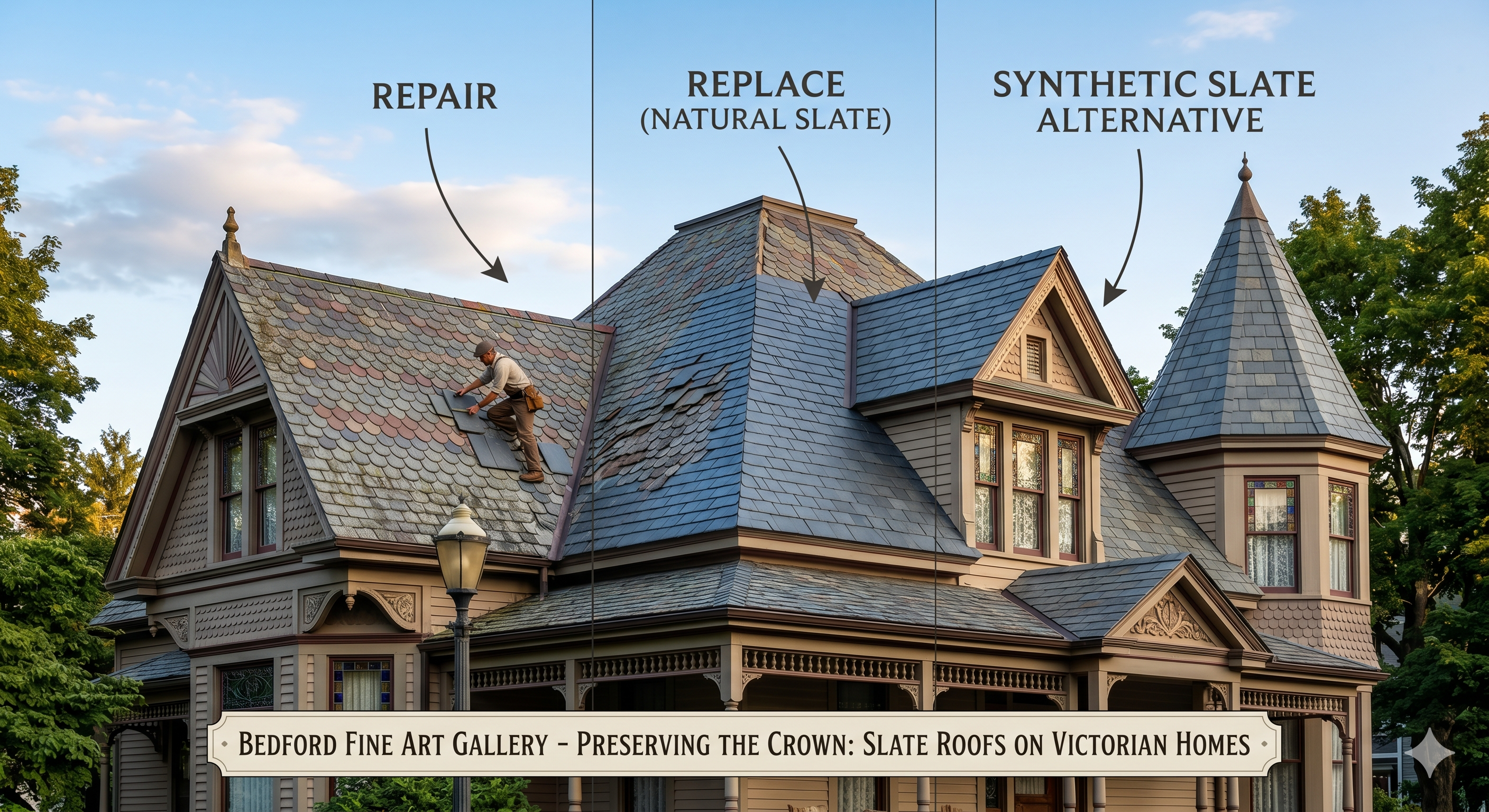
If you own a historic home with a failing slate roof, you face a key decision: repair the original, replace it with new slate, or consider modern synthetic alternatives.
This guide will help you determine the best approach for your historic home’s slate roof.
The Allure (and Anatomy) of the Original Slate
Understanding a slate roof’s lifespan is essential. High-quality slate, sourced from regions like Pennsylvania, Vermont, or Wales, can last from 75 to over 200 years.
However, a roof is a system. While slate may last for centuries, the nails and flashing that secure it do not. Nails can rust and flashing can deteriorate over time, so many slate roof failures are due to these components rather than the stone itself.
When to Repair
In historic preservation, it is best to retain and repair original materials whenever possible. Repair is recommended if:
- Less than 20% of the tiles are damaged. If only a few slates are broken, missing, or slipping, a specialist can replace them using copper slate hooks.
- The slate remains hard. If tapping a tile produces a clear, sharp ring, the stone is still in good condition.
- The problem is localized. If leaks occur only around chimneys, valleys, or dormers, replacing the flashing is usually sufficient. A skilled roofer can remove nearby slates, install new flashing, and reinstall the original tiles.
Note: Do not allow a roofer to use tar or sealant to secure slipping slates. This temporary fix damages both the appearance and integrity of the historic roof.
When to Replace (with Natural Slate)
In some cases, total replacement with natural quarried slate is necessary if:
- The slate is delaminating. If tiles are flaking, crumbling, or produce a dull sound when tapped, the stone has reached the end of its lifespan.
- Widespread nail deterioration. If nails throughout the roof have failed, slates will slip out of place. Removing and re-nailing every slate is often as labor-intensive and costly as full replacement.
- The roof decking is rotting. If the wood beneath the slate has decayed from prolonged leaks, the entire roof must be removed to rebuild the structure.
Replacing with natural slate is a significant investment, but it is the only way to fully replicate the historical accuracy, texture, and patina of the original roof. It also provides long-term protection.
The Modern Compromise: Synthetic Slate Alternatives
Recently, synthetic slate made from plastics, rubber, and polymer composites has become popular in restoration projects. Is it suitable for your Victorian home?
The Pros of Synthetic Slate:
- Weight: Natural slate is very heavy, sometimes up to 1,500 pounds per square. Over time, this weight can cause old roof trusses to sag. Synthetic slate is much lighter, reducing stress on the structure.
- Cost: Synthetic slate is generally more affordable than natural slate, as it is faster and easier to install.
- Durability: High-quality synthetic slates are impact-resistant and often come with 50-year warranties.
- Aesthetics: The best synthetic slates are molded from real slate, closely replicating the natural texture and color variations of original Victorian roofs.
The Cons of Synthetic Slate:
- The Purist Perspective: To a trained eye, up close, synthetic slate lacks the subtle, organic variation and light-reflecting qualities of natural stone. If your home is listed on a strict historic register, local architectural review boards may not permit synthetic materials.
- Unknown Century-Long Longevity: While synthetics have great 50-year warranties, we simply haven't had them long enough to know if they will survive a full century or more like natural stone.
- Fading: Although modern polymers are UV-resistant, all will eventually fade over time. Natural slate, by contrast, develops a patina that enhances its appearance.
The Verdict for Your Victorian
Deciding how to address your Victorian home’s slate roof requires balancing budget, structural needs, and historical authenticity.
If your original slate is still in good condition, repair is the best option. Nothing matches the authenticity of a 19th-century roof. If replacement is necessary, natural slate is ideal for historical accuracy. However, if weight or budget are concerns, high-quality synthetic slate is a durable and attractive alternative that will protect your home for generations.
Just as a fine art restorer evaluates a 19th-century oil painting—deciding when to clean, when to patch, and when to leave the natural craquelure alone—a historic homeowner must approach their roof with patience and respect. By choosing the right path for your slate, you ensure that the crown jewel of your Victorian home shines on.
If you appreciate 19th-century craftsmanship, explore our collection of preserved artwork at Bedford Fine Art Gallery, where history and beauty are always on display.