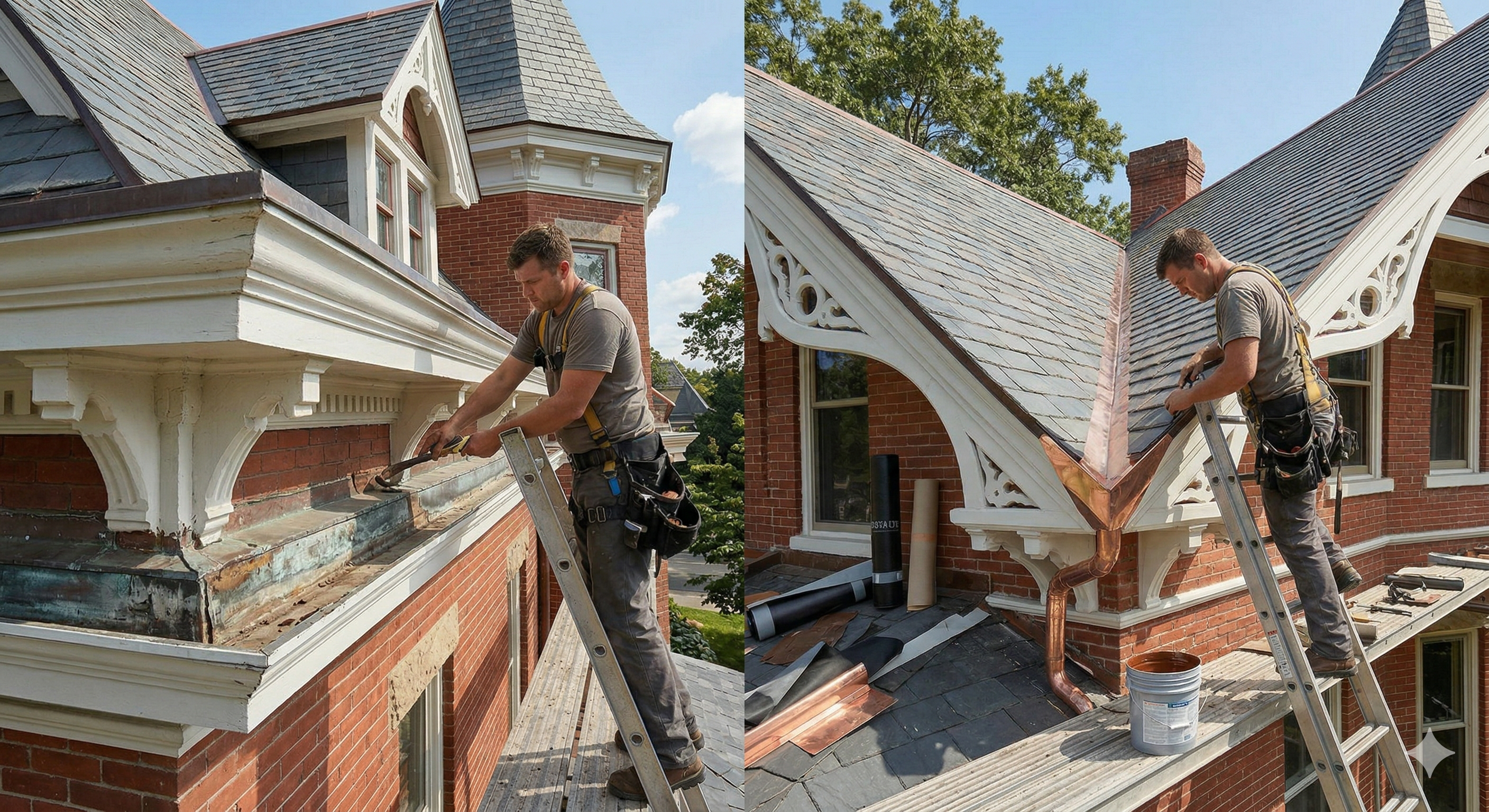
Owning a Victorian home means preserving ornate details and classic charm. Yet managing water is a vital, often-overlooked reality beneath the historic romance.
If your Victorian home retains its original roofline, you likely don’t have standard aluminum K-style gutters; consider a Victorian roof restoration for optimal maintenance. Instead, you probably have built-in drainage systems—box gutters or Yankee gutters.
Because these systems are hidden from view, they are the unsung heroes of your home’s exterior. However, being out of sight can lead to neglect, which may result in water damage, wood rot, and structural issues; learn more about moisture and foundation issues. This guide helps you understand, maintain, and reline your Victorian gutters.
Understanding Your Built-In Gutters
Before diving into maintenance, it helps to know exactly what directs water off your roof. Both box and Yankee gutters were designed to preserve the crisp, ornate architectural lines of 19th-century roof eaves without the visual clutter of external metal troughs.
- Box Gutters: These are literally wooden "boxes" framed into the bottom of the roof structure, typically sitting inside the cornice (the decorative molding at the top of the wall) or roof overhang. They are usually lined with metal to catch and funnel water.
- Yankee Gutters: Often confused with box gutters, Yankee gutters are actually built directly into the roof slope, slightly set back from the roof edge. They consist of a wooden V- or U-shaped trough built over the roof deck, also lined with metal.
Because both systems are integrated into the wood framing of the house, a failure in the lining doesn't just drip water onto your flowerbeds. It funnels water directly into your home's soffits, fascia, walls, and eventually the foundation.
The Golden Rule: Routine Maintenance
The single best way to protect your Victorian is to keep water flowing exactly where it’s supposed to; refer to our post-winter inspection checklist for guidance.
1. Frequent Cleaning Built-in gutters are notorious for catching leaves, twigs, and debris. They are often wider and flatter than modern gutters and don't self-flush effectively during heavy rains. You should clean them out at least twice a year—once in late fall and once in spring.
2. Visual Inspections While cleaning, play detective. Look for:
- Alligatoring or cracking in old tar or liquid coatings.
- Failed seams where the metal lining pieces are soldered together.
- Ponding water, which indicates the wood framing has sagged over time and lost its proper pitch toward the downspout.
- Soft spots in the wood beneath the lining.
3. Clear the Scuppers and Downspouts The "scupper" (the opening or hole where water drops from the gutter into the downspout) is a major choke point. Make sure wire strainers are installed over the scupper holes to prevent clogs deep within the vertical pipes called downspouts.
Lining Options for Restoration and Repair
Even with immaculate maintenance, the lining of your box or Yankee gutters will eventually reach the end of its lifespan. When the time comes for relining or a full rebuild, you have three primary paths to choose from, balancing historical accuracy, longevity, and budget.
1. The Traditional Route: Sheet Metal
If your goal is strict historical accuracy and longevity, metal is the gold standard.
- Copper: The premium choice for historic homes. Properly installed, soldered copper liners can last 50 to 100 years. It patinas beautifully and requires little maintenance. The downside? It is very expensive and requires a specialized copper smith or historic roofer to install correctly.
- Terne-Coated Stainless Steel (TCS): Historically, tin or lead-coated steel was used. Today, TCS, which is stainless steel coated with a combination of tin and iron, is a fantastic, highly durable alternative. It takes solder well, resists corrosion, and eventually weathers to a muted, historically appropriate gray.
2. The Modern Standard: Single-Ply Membranes
For homeowners seeking reliable waterproofing at a more affordable price point, modern roofing membranes have become increasingly popular for built-in gutters.
- EPDM (Rubber): A thick, flexible rubber membrane called EPDM (ethylene-propylene-diene monomer) is commonly used on flat commercial roofs. EPDM is seamless, eliminating the risk of solder joint failures, and flexes well with the expansion and contraction of your home's wood framing. It’s cost-effective and can last 20–30 years.
- TPO or PVC: Similar to EPDM but made from plastic/vinyl materials. TPO (thermoplastic polyolefin) and PVC (polyvinyl chloride) membranes have heat-welded seams rather than glued ones, making them nearly impervious to standing water.
- A note on membranes: While not historically accurate, the membrane is entirely concealed from the street, making it an excellent compromise for preserving the home's look while ensuring modern water protection.
3. The Life-Extender: Liquid-Applied Coatings
If your metal liners are aging but not completely rusted through, you might be able to buy yourself a decade of time with a liquid coating.
- Silicone or Urethane Systems: These are high-build, professional-grade liquids that are applied directly over cleaned, existing metal. They curve into a seamless rubber-like shell.
- The Catch: Preparation is everything. If the old metal isn't thoroughly cleaned, stripped of flaking rust, and primed, the coating will peel away within a year. This is a temporary fix (5–15 years) rather than a permanent restoration.
The Bottom Line
Box and Yankee gutters are defining features of Victorian architecture. While they require more vigilance than a standard modern gutter, preserving them maintains the historical integrity and character of your home. If you suspect an issue, don't wait for a rainy day to find out—consult a roofer specializing in historic homes to assess your system and keep your Victorian standing proud for another century.