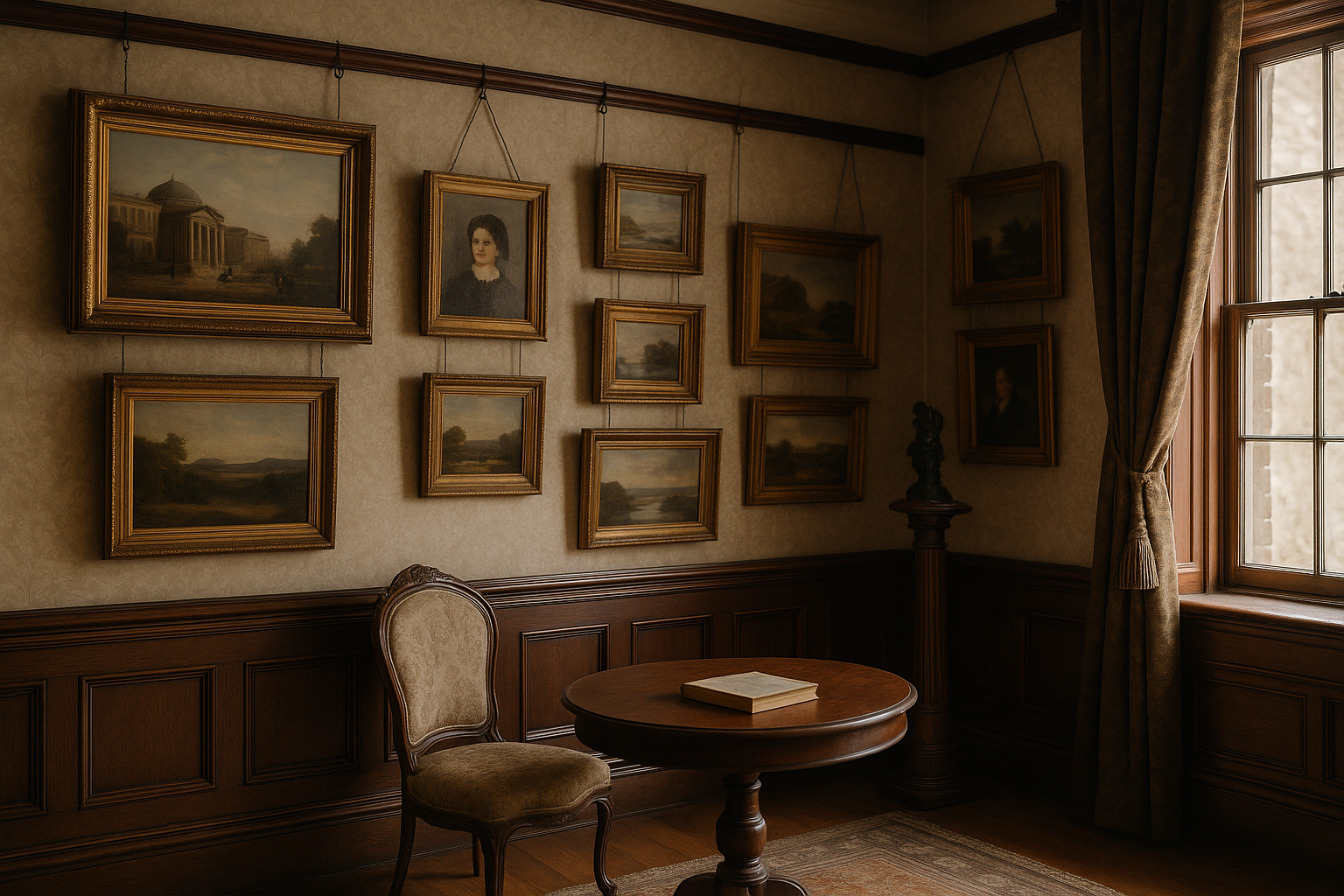
If you own a Victorian home, you've likely noticed something that puzzles most modern decorators: the picture rail. That narrow strip of molding running horizontally near the ceiling wasn't decorative in the accidental sense — it was an elegantly engineered system that shaped how Victorians lived with art, and it reveals an entire philosophy of interior design that's both historically rich and remarkably practical today.
Understanding how Victorians hung, grouped, and chose their art is one of the most rewarding — and authentic — ways to bring your historic home back to life.
What Is a Victorian Picture Rail, and Why Does It Matter?
In the Victorian era (roughly 1837–1901), drilling into plaster walls was neither easy nor desirable. Plaster walls were painstakingly crafted, often layered three coats thick, and punching holes in them was considered careless and destructive.
The picture rail solved this beautifully. Installed just below the crown molding or cornice, the picture rail allowed homeowners to hang S-shaped hooks and long cords — called picture cord or hanging wire — from which frames could be suspended at any height. This meant:
- No nails in the plaster walls
- Artwork could be repositioned freely without damage
- Multiple frames could hang from a single hook, stacked vertically in a technique called salon hanging
If your Victorian home still has its original picture rail intact, consider yourself fortunate, as it is a key aspect of historic preservation. It is one of the most historically accurate — and functional — features a Victorian interior can have. Many homeowners who have removed theirs during renovations later wish they had kept it.
The Victorian Approach to Art: More Is More (But Intentionally So)
The modern decorating instinct leans toward minimalism — one statement piece per wall, plenty of breathing room, neutral backdrops. Victorian decorating philosophy was nearly the opposite, and understanding why helps you apply it thoughtfully rather than chaotically.
The Victorians collected deliberately. Art in a Victorian home was:
- A display of taste and cultivation — owning original paintings, prints, and engravings signaled that a family valued beauty and learning
- A record of travel and experience — landscapes, portraits, and genre scenes told the story of where a family had been and what they admired
- A conversation starter — parlors were social rooms, and art gave guests something to discuss
This is why Victorian walls were often covered nearly floor to ceiling in frames of different sizes. The effect, when done well, is not cluttered — it is curated. Every piece had a reason to be there.
Salon Hanging: The Victorian Art of the Gallery Wall
Long before the term "gallery wall" existed, Victorians were masters of it. Their method, called salon hanging (named after the famous Paris Salons where paintings covered every inch of wall space), followed specific principles:
1. Anchor with a Large Central Piece
The largest, most important painting in a grouping was typically placed at eye level in the center. Everything else was arranged around it — above, below, and to the sides — in a way that balanced visual weight rather than followed rigid symmetry.
2. Mix Frame Styles Within a Cohesive Palette
Victorians mixed gilded frames, dark walnut frames, and ornate carved frames freely — but within a room that shared consistent wall color and molding. The variety of frames read as richness rather than disorder against a cohesive backdrop.
3. Use Cord and Hook Intentionally
The visible picture cord was not hidden — it was often a rich velvet ribbon, a braided silk cord, or a decorative chain. This visible hanging mechanism was considered part of the aesthetic and drew the eye upward, connecting the artwork to the architectural molding above.
4. Layer Vertically
It was common to see three paintings hung in a vertical column from a single hook — a large landscape at the center, a smaller portrait above, and a decorative print below. The eye traveled naturally up and down the cord, reading each piece in sequence.
What Types of Art Did Victorians Actually Hang?
Knowing the kinds of art that were authentic to Victorian interiors helps you make historically grounded choices for your own home. The most common categories included:
Oil Paintings
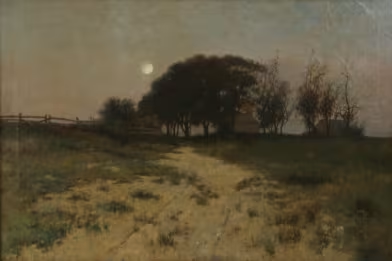
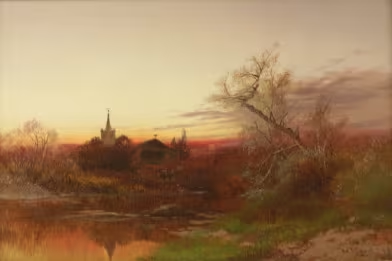
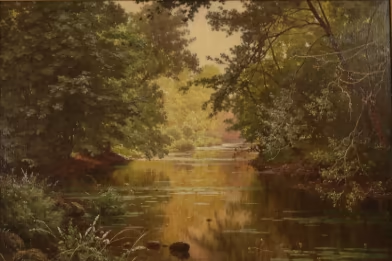
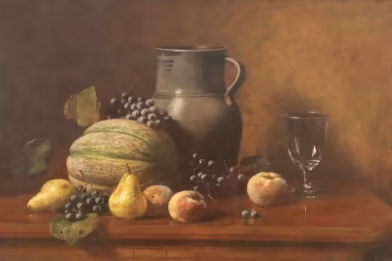
Original oil paintings were highly prized. Landscapes were enormously popular — the Hudson River School in America and the British pastoral tradition in England both produced works that found their way into Victorian parlors and sitting rooms. Genre scenes (everyday life depicted realistically), portraits, and still lifes were also common.
Steel Engravings and Lithographs
Not every Victorian family could afford original oils, but high-quality reproductions in the form of steel engravings and lithographs were widely available and considered entirely appropriate for display. These were often purchased framed and ready to hang.
Chromolithographs
As color printing technology advanced in the later Victorian period, chromolithographs — colorful printed images that mimicked the look of paintings — became popular for secondary rooms, children's rooms, and less formal spaces.
Portraits and Family Likenesses
Formal family portraits were considered essential in any prosperous Victorian home. These were often the largest paintings in the house and were given the most prominent positions.
Watercolors
Watercolor painting was considered a refined accomplishment, particularly for women, in the Victorian era. Many households displayed original watercolors created by family members alongside purchased works.
Choosing Art for a Victorian Home Today: Authenticity vs. Accessibility
One of the most common questions Victorian homeowners ask is whether original period art is necessary for an authentic look — or whether reproductions, prints, or contemporary work is acceptable.
The honest answer is that Victorians themselves mixed originals with reproductions freely, so you are well within the historical spirit of the era when you do the same. That said, there is something genuinely different about an original oil painting — the texture of the brushwork, the depth of the surface, the way light plays across it — that no print can fully replicate.
Original 19th-century paintings and quality period prints are more accessible than many people assume. Antique paintings and period artwork do appear at estate sales, antique galleries, and through specialized dealers — and many are priced very reasonably compared to contemporary art.
For homeowners in Pennsylvania, surrounding region, and around the world Bedford Fine Art Gallery in Bedford, Pennsylvania has spent nearly four decades helping Victorian homeowners find exactly this kind of art. Bedford Fine Art Gallery only sells original fine art (oil, pastel, watercolor, gouache, and mixed media) The gallery operates out of an 1889 Victorian home that has been authentically restored, which gives the owners a particularly practiced eye for what works in these spaces. If you're searching for something specific — a landscape for a parlor wall, a portrait for an entrance hall, or a still life for a dining room — it's worth reaching out to specialists who understand both the art and the architecture.
Practical Tips for Recreating a Victorian Picture Hanging Display
Whether your home still has its original picture rail or you're working with walls that have been modified over the years, here are practical steps for creating an authentic Victorian display:
Restore or Install Picture Rail Molding
Picture rail molding is still manufactured today and is available through specialty millwork suppliers. If your home had picture rails that were removed, reinstalling them is a relatively straightforward carpentry project and is one of the most impactful restorations you can make to your walls.
Use Period-Appropriate Hanging Hardware
Reproduction brass S-hooks, picture cord in velvet or braided cotton, and decorative picture chains are all available online and through restoration hardware suppliers. The hanging hardware is visible, so it matters.
Choose a Strong Wall Color
Victorian walls were rarely white or off-white. Deep colors — Prussian blue, forest green, burgundy, olive, terracotta — were the norm, and for good reason: they make gilded frames and dark oil paintings sing. If you've been hesitant about committing to a bold wall color, a Victorian parlor or sitting room is exactly the right place to try it.
Group Before You Hang
Lay your paintings on the floor and arrange them before putting anything on the wall. This allows you to experiment with groupings, balance large and small pieces, and see how the overall collection reads together.
Don't Neglect the Mantelpiece
Victorian mantelpieces were display surfaces in their own right. Propping a painting or mirror above a mantel, flanked by decorative objects, is an entirely authentic look and one of the easiest ways to introduce original art into a Victorian room without committing to a full gallery wall.
The Living Quality of a Well-Decorated Victorian Room
What strikes visitors to authentically decorated Victorian homes is not ostentation — it is personality. These rooms feel lived in, collected over time, full of stories. Each piece of art represents a choice, an interest, a memory.
Modern interiors, for all their elegance, can feel like they arrived complete from a showroom. Victorian rooms feel like they were built by a life.
That quality is achievable. It doesn't require unlimited funds or instant acquisition. It requires patience, discernment, and the willingness to seek out pieces that genuinely speak to you — the way the Victorians always did.
Start with one wall. Find one painting that belongs in your home. Hang it the way the Victorians would have, with care and intention, and see what the room becomes.